Centering Down - The Adequacy of Thomas Kelly
Emerging from the depths, he taught us about depth
Note: This essay, with a few edits, was first delivered as a reflection at the Cathedral of the Rockies Candlelight Service on February 3, 2026. You can watch a video of the reflection here.
In December of 1934 Thomas Kelly had a nervous breakdown. “During that winter,” one of his former students [1] wrote, “he had strength only to get out of bed and wobble unprepared to his classes.” Early the next year he finished his doctoral thesis for Harvard but was not allowed to defend it. He already had a Ph.D. from a theological seminary and was teaching in a prestigious school but, as Howard Macy commented, “He longed for the kind of recognition a Harvard Ph.D. would grant him.” [2) The folks at Harvard couldn’t understand why he would want another doctorate on top of the one he already had.
He tried again in 1937. He published the dissertation himself in 1937 but during his oral examination he had a memory lapse and failed. He went into, Jones writes, “…one of his ‘woozy spells’…and his mind blanked.” The Harvard committee testing him said he did so poorly that he would never be able to try for their doctorate again.
He was “totally crushed by this irreversible failure” and sank into a deep depression, which scared his wife, and he had to be assured by the President of the university where he was working and another colleague that his talents and accomplishments were plenty worthy, even without a Harvard degree, and that his job was secure.
He had counted on the Ph.D. to support his goals as a scholar, but that dream had just gone down the drain.
He was grieving. His life was a mess.
But soon after he had a spiritual awakening. “No one knows exactly what happened,” Douglas Steere wrote [3], but the dark days of his life were over. “A fissure in him seemed to close, cliffs caved in and filled up a chasm, and what was divided grew together in him.”
“Within months,” Howard Macy wrote [2] “…out of the ruins of this dream rose a new, capturing vision.” He had experienced suffering himself but also was formed by the suffering of others. He made his “breakthrough,” Macy says, at the age of 44.
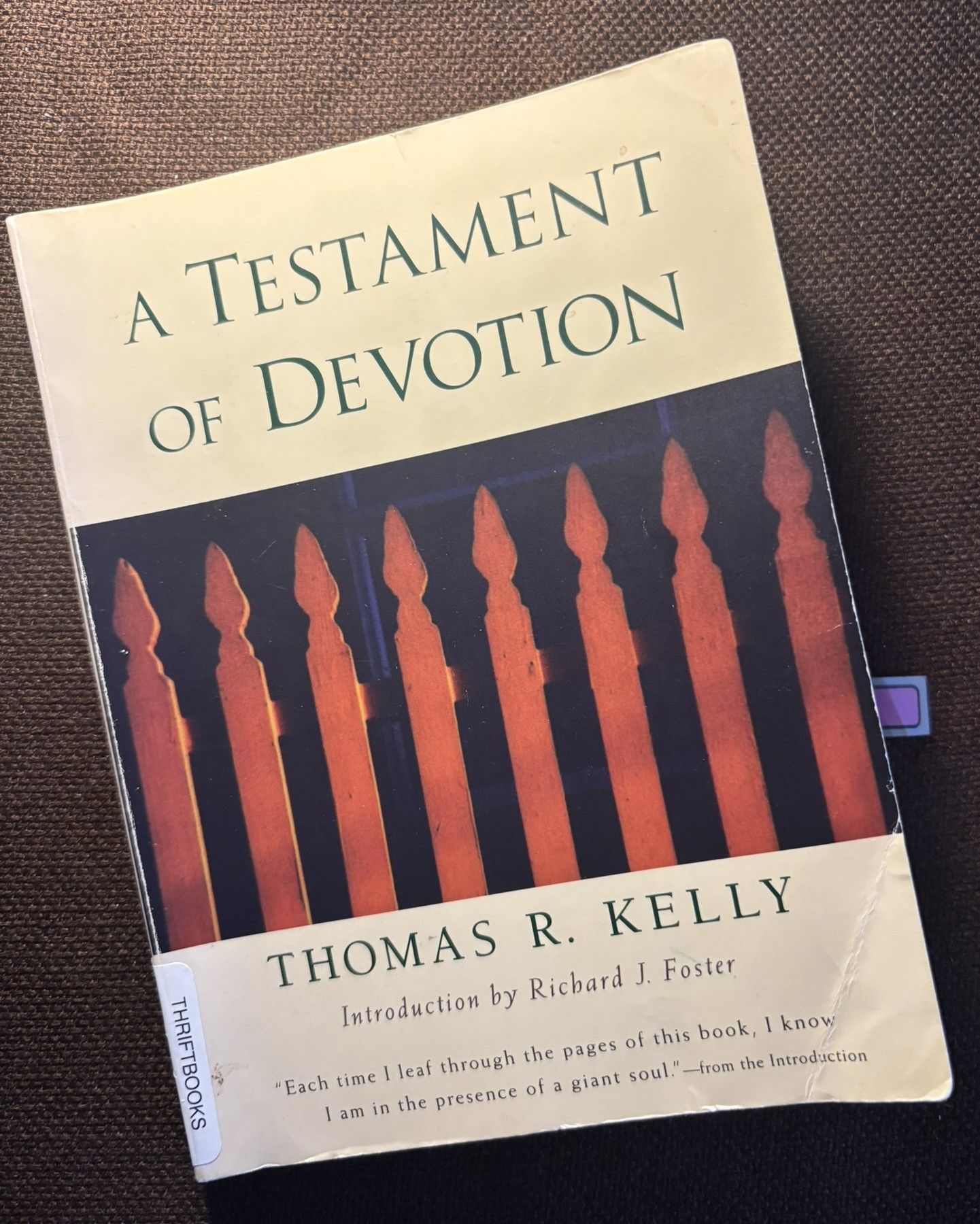
When I first read Thomas Kelly’s book, A Testament of Devotion, I was stunned.
When I first read Thomas Kelly’s book, A Testament of Devotion, I was stunned. It was like his words pierced through a myriad of questions and thoughts I had about religion and spirituality and life and struck right to my core. I don’t remember how I found him. When I did, I knew almost nothing about his Quaker religion, and absolutely nothing about his story. But time and again I have come back to this book, referred to it – as I’m doing here – and thought seriously about what it would mean to me to “center down.”
He wrote,
Deep within us all there is an amazing inner sanctuary of the soul, a holy place, a Divine Center, a speaking Voice, to which we may continuously return…it is a Light Within which illumines the face of God and casts new shadows and new glories upon the face of men…It is the Shekinah of the soul, the Presence in the midst. Here is the Slumbering Christ, stirring to be awakened, to become the soul we clothe in earthly form and action. And He is within us all.
Kelly urged us to practice “the prayer of inward listening.” Canby Jones described it as:
“Only in the deep, centered down, silences of the soul can we hear that still small voice, can we feel the gentle nudgings of the Lord, speaking, guiding, showing us the path… There is no experience of divine guidance apart from the practice of inward listening.”
I have thought long and hard about centering, centering down, moving away from the superficial and toward the deeply meaningful - and realized that for way too much of my life I was pursuing things that just didn’t matter. I do better now but it is, I’ve found, a lifelong journey. The world pushes the immediate, the loud, the glittering, the variable reinforcement schedule of slot-machine-living. But it’s the extraordinarily meaningful joy of ordinary day-to-day appreciation for things that have lasting value - like my marriage, my wife, my children, my friends, and trying to do something that makes a difference for others that is the real gold of a centered life. Fool’s gold just seems to vanish, doesn’t it?
Poof.
On January 17, 1941 Kelly learned that a publisher was willing to meet with him to discuss the publication of a book. He died of a heart attack later that same day. He was 47.
Three months later, Douglas Steere, the same colleague who had helped talk him out of despair after he failed his Harvard examination, submitted five of Kelly’s devotional essays to the publisher. The book was published under the title A Testament of Devotion. Some of his other essays were also collected in a book entitled The Eternal Promise. [5]
“An adequate life,” Douglas Steere wrote:
“…might be described as a life which has grasped intuitively the whole nature of things, and has seen and felt and refocused itself to this whole. An inadequate life is one that lacks this adjustment to the whole nature of things—hence its twisted perspective, its partiality, its confusion. The story of Thomas Kelly’s life is the story of a passionate and determined quest for adequacy.“
“Adequacy” seems like such a mundane aspiration in this world today, where we extol the latest fashion, the ultra wealthy, having the most followers, and celebrity of all types. But to aspire to adequacy as Steere describes it seems like something all of us mere mortals can shoot for.
Adequacy in this sense would be a perfect description of my grandfather’s life, perhaps the wisest, most virtuous, person I have ever known - who gave up a promising career in education to return to run the family farm when his father-in-law died. No glitter for him, just preparing, planting, and harvesting. And then doing it again.
I would like to become more adequate, more centered down as I travel forward into my later life.
From the messiness of punctured dreams, Thomas Kelly had moved toward wholeness. He became adequate.
Notes
[1] T. Canby Jones, one of Kelly’s students, wrote, Thomas R. Kelly: As I remember him (Kindle ed.). Pendlehill Publications.
[2] Macy, H. (2016). Foreword. In T. Kelly, The Eternal Promise (3 ed., pp. vii-xv). Friends United Press.
[3] Steere, D. V. (1996). A Biographical Memoir. In T. Kelly, A Testament of Devotion (pp. 101-127). HarperSanFrancisco.
[4] Kelly, T. R. (1996). A testament of devotion. HarperSanFrancisco.
[5] Kelly, T. (2016). The Eternal Promise (3rd ed.). Friends United Press.
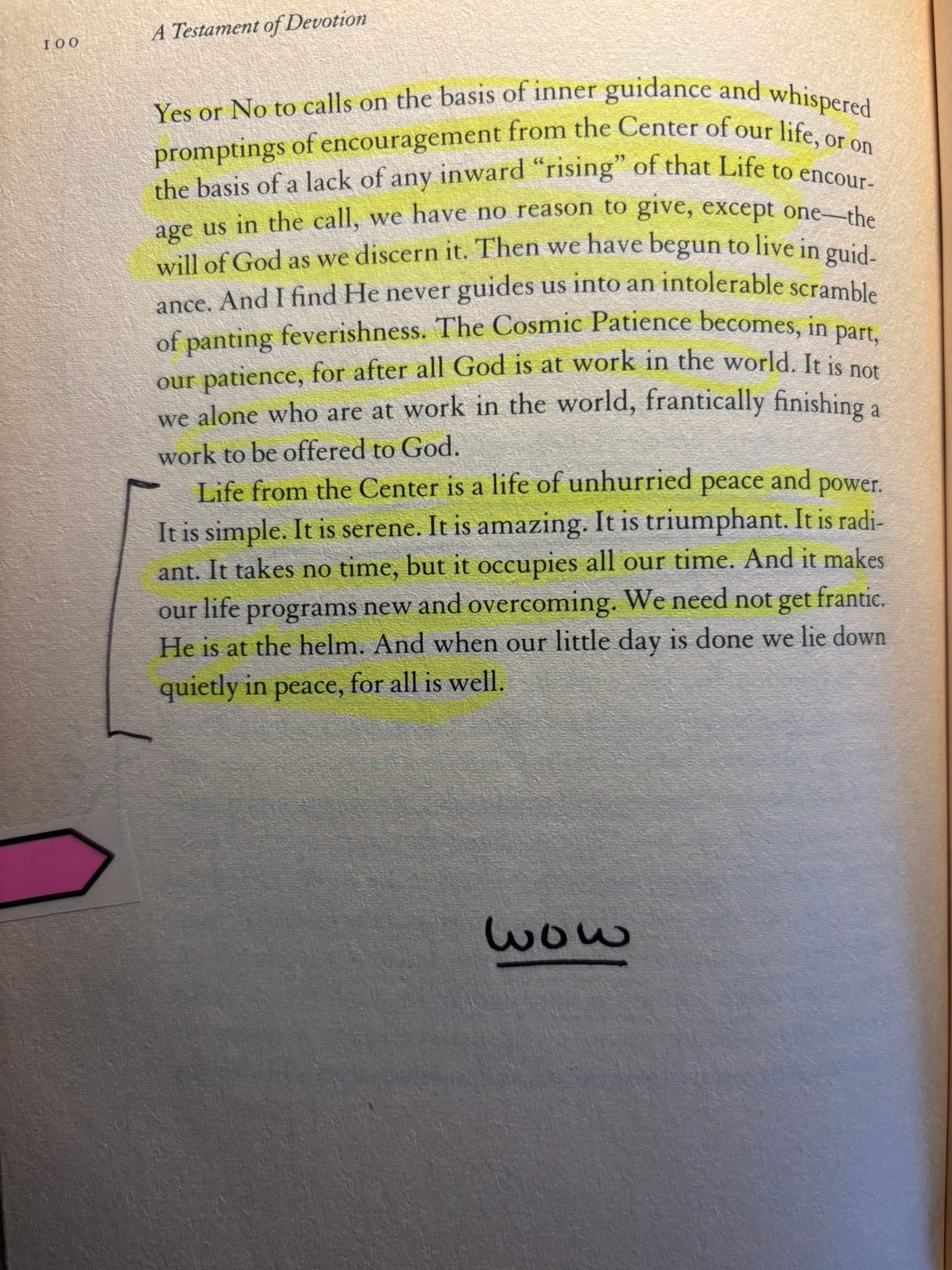
From my old, used, tattered book, A Testament of Devotion. WOW was all I could write when I first read this, years ago.
“Life from the Center is a life of unhurried peace and power. It is simple. It is serene. It is amazing. It is triumphant. It is radiant. It takes no time, but occupies all our time. And it makes our life programs new and overcoming. We need not get frantic. He is at the helm. And when our little day is done we lie down quietly in peace, for all is well.”